The Weight of Legacy
Every enterprise carries baggage. Decades-old applications that still process payroll, manage supply chains, or serve millions of customers daily. They work — barely — but they’re slow to change, expensive to maintain, and impossible to innovate on top of.
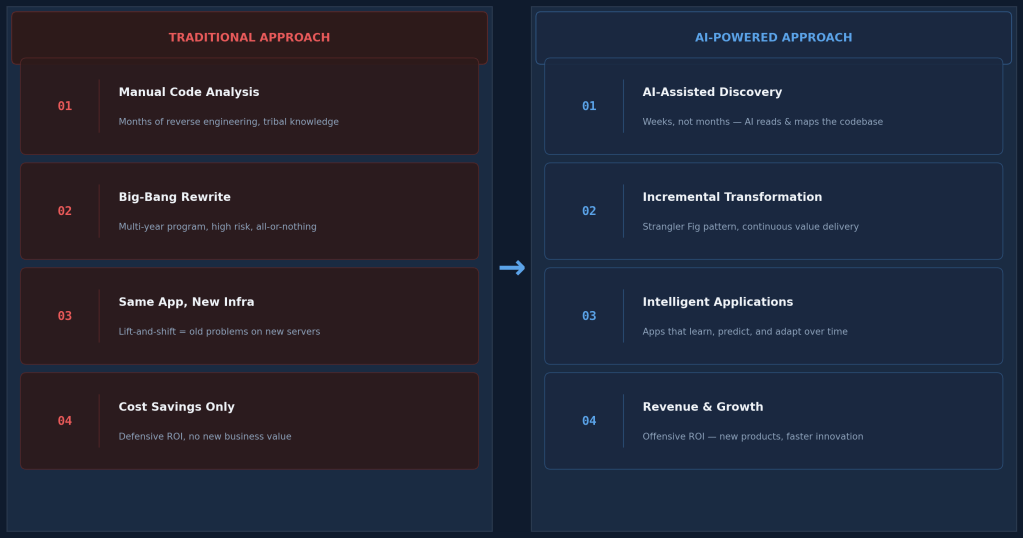
For years, “modernization” meant rewrite everything (risky, expensive) or lift-and-shift to the cloud (faster, but you’re just running old problems on new infrastructure). Neither approach truly unlocked new value.
AI is changing that equation entirely.
What’s Different Now?
AI isn’t just another feature to bolt on. It fundamentally changes how we approach modernization.
AI understands your legacy code — so you don’t have to. Nobody fully knows the old system anymore. The original developers left years ago. Documentation is missing. AI-powered tools like Amazon Kiro can now read, analyze, and explain legacy codebases — mapping dependencies, identifying business rules, and suggesting how to decompose monoliths into modern services. What took months now happens in weeks.
From “migrate” to “transform.” Traditional modernization asks: “How do I move this somewhere better?” AI-driven modernization asks: “How do I make this smarter?” Using services like Amazon Bedrock, you can embed intelligence into existing workflows — auto-classifying claims, predicting processing times, routing complex cases to the right people. The application doesn’t just run faster; it thinks.
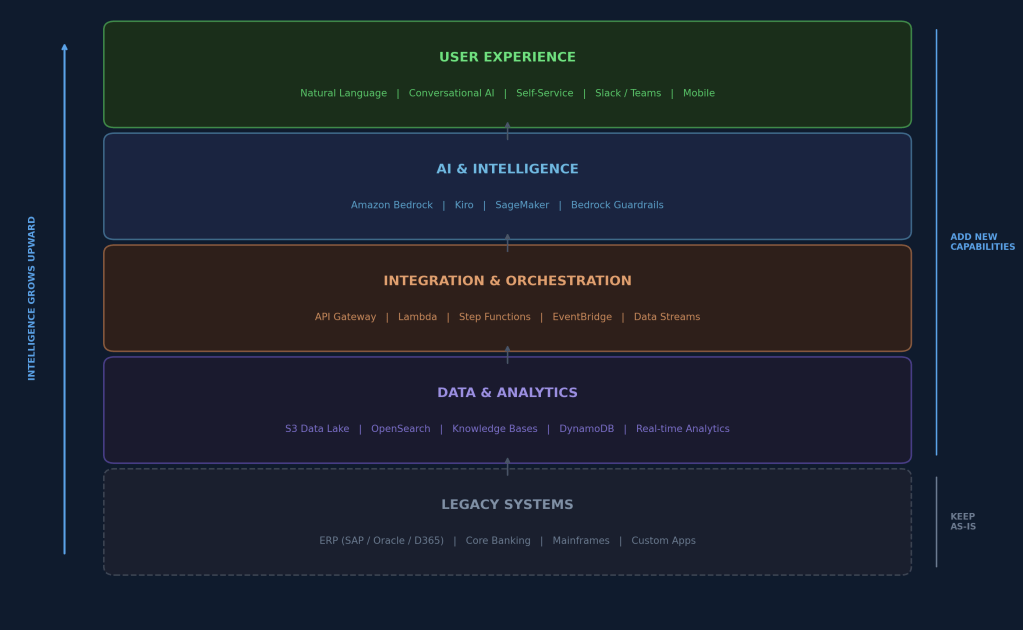
Continuous, not big-bang. You can wrap AI capabilities around existing systems without rewriting them. A legacy ERP gains conversational interfaces through Bedrock Agents. An old CRM starts predicting churn using SageMaker. Each layer of intelligence adds value without requiring a full replatform.
The Cloud + AI Advantage
| Challenge | How Cloud + AI Solves It |
| Legacy code nobody understands | AI-powered code analysis and transformation |
| Trapped data with no insights | Managed AI services extract value without rebuilding |
| Rigid, monolithic architectures | Serverless patterns that evolve incrementally |
| Inability to experiment | Pay-as-you-go AI services let you prototype cheaply |
| Skill gaps in the team | AI assistants accelerate developers 3-5x |
The key insight: the cloud isn’t just where your modernized app lives — it’s the intelligence layer that makes modernization worthwhile.
The Strangler Fig pattern — gradually growing new capabilities around a legacy system — gets supercharged with AI:
- Faster understanding — AI identifies which pieces to modernize first (highest value, lowest risk)
- Smarter routing — AI-powered gateways route requests between old and new components intelligently
- Automated testing — AI generates test cases from legacy behavior, ensuring equivalence
The Leadership Imperative
This is no longer an IT decision. It’s a strategic business decision that demands executive attention.
The ROI equation has flipped. Traditional modernization ROI was defensive: “save X% on hosting.” AI-powered modernization is offensive — new revenue streams, faster time-to-market, better customer experiences, compounding efficiency gains. When you frame it as “unlocking $50M in revenue” instead of “saving $5M in costs,” it becomes a different boardroom conversation.
What Great Leaders Do Differently
- Fund outcomes, not projects. Not “3-year modernization program” but “reduce claims processing time by 60%.”
- Create space for experimentation. Allocate 10-15% of budgets to rapid prototypes using managed AI services.
- Break the “all or nothing” trap. Pick one high-value application, prove the model, scale.
- Invest in people alongside technology. Pair cloud/AI investments with upskilling — the biggest failures are cultural, not technical.
If your biggest competitor deployed AI across their core operations tomorrow, how long would it take you to respond with your current systems?
If the answer is “years,” that’s your modernization urgency.
Getting Started
- Where is human effort wasted on repetitive decisions? That’s your first AI opportunity
- What data is locked inside legacy systems? Unlocking it with APIs or event streams creates immediate value.
- Which applications hold back business agility? Prioritize those for deeper transformation — not just migration.
The Intelligent Platform Architecture
The Bottom Line
Application modernization is no longer a cost-reduction exercise. It’s a value-creation strategy. The cloud gives you the foundation. AI gives you the intelligence. Together, they turn modernization from a painful necessity into a competitive weapon.
The question isn’t whether to modernize. It’s whether you’ll modernize for yesterday’s standards — or tomorrow’s intelligence.

